If you’re using the Toolkit, enable the git-bridge by setting the following in your config/overleaf.rc:
config/overleaf.rc
GIT_BRIDGE_ENABLED=true
2
Add the git-bridge container (For Docker-compose user Only)
For users running a custom docker-compose.yml, add the following container configuration to your compose file:
docker-compose.yml (git-bridge service)
git-bridge:
    restart: always
    image: ghcr.io/ayaka-notes/overleaf-pro/git-bridge:6.3.0 # tag should match the `sharelatex` container tag
    volumes:
        - ~/git_bridge_data:/data/git-bridge
    container_name: git-bridge
    expose:
        - "8000"
    environment:
        GIT_BRIDGE_API_BASE_URL: "http://sharelatex:3000/api/v0/"
        # "http://sharelatex/api/v0/" for version 4.1.6 and earlier
        GIT_BRIDGE_OAUTH2_SERVER: "http://sharelatex"
        GIT_BRIDGE_POSTBACK_BASE_URL: "http://git-bridge:8000"
        GIT_BRIDGE_ROOT_DIR: "/data/git-bridge"
    user: root
    command: ["/server-pro-start.sh"]
3
Update the sharelatex container configuration
You’ll also need to link the git-bridge container in the sharelatex container and define the following environment variables, please pay attention to V1_HISTORY_URL:
docker-compose.yml (sharelatex service)
sharelatex:
    links:
        - git-bridge
    environment:
         GIT_BRIDGE_ENABLED: true
         GIT_BRIDGE_HOST: "git-bridge"
         GIT_BRIDGE_PORT: "8000"
         # We use v1 now, if you used to set V1_HISTORY_URL, please update now
         V1_HISTORY_URL: "http://sharelatex:3100/api"
4
Authentication
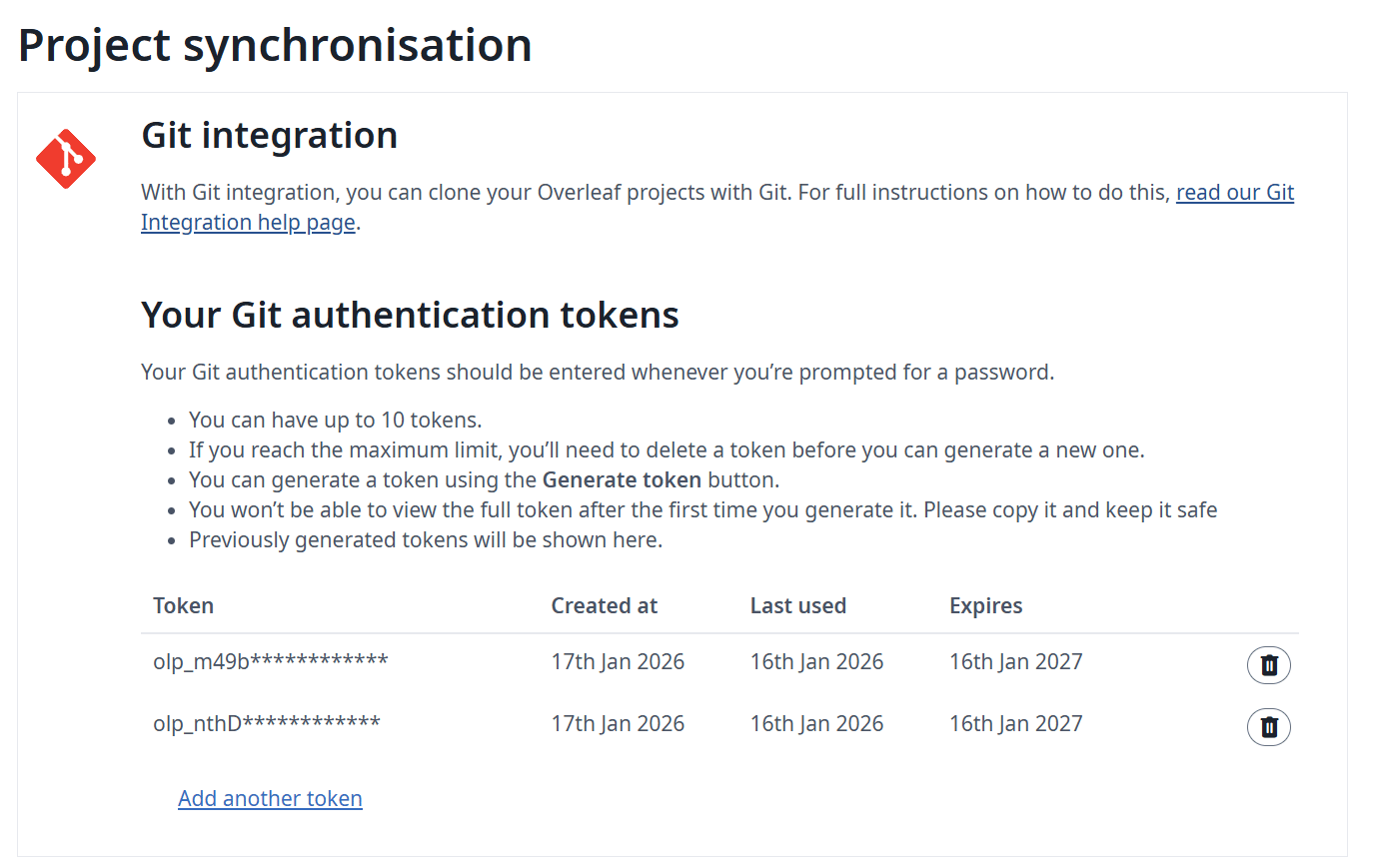
When authenticating a git client, users need a Personal Access Token. Users can manage Personal Access Tokens through the application UI (see the documentation):
Git Intergration Personal Access Token
5
Monitoring and resource considerations
We recommend you monitor your host resources after enabling the git-bridge. The load increase will depend on:
the number of users accessing the feature
the types of projects hosted in your instance (larger projects are generally more resource intensive)
The Git integration stores a complete git repository on disk for each project that gets cloned by a user. If you have limited disk space, you can activate a swap job that will move repositories that are less used to AWS S3. If a swapped repository is needed again, it gets moved back to the disk. The following environment variables control the swap job:
Name
Description
GIT_BRIDGE_SWAPSTORE_TYPE
Set this to “s3” to activate the swap job.
GIT_BRIDGE_SWAPSTORE_AWS_ACCESS_KEY
Your AWS access key
GIT_BRIDGE_SWAPSTORE_AWS_SECRET
Your AWS secret
GIT_BRIDGE_SWAPSTORE_S3_BUCKET_NAME
This bucket will contain the zipped git repositories
GIT_BRIDGE_SWAPSTORE_AWS_REGION
The bucket’s region
GIT_BRIDGE_SWAPJOB_MIN_PROJECTS
How many projects to keep on disk, at a minimum.
- Default: 50
GIT_BRIDGE_SWAPJOB_LOW_GIB
Low watermark for swapping. The swap job will move projects until disk usage is below this value.
- Default: 128 GB
GIT_BRIDGE_SWAPJOB_HIGH_GIB
High watermark for swapping. The swap job will start swapping when disk usage reaches this value.
- Default: 256 GB
GIT_BRIDGE_SWAPJOB_INTERVAL_MILLIS
The amount of time between checking disk usage and running the swap job.
If I share my project with someone else, how does the Git Bridge permission model work?
Users with read-only access can only clone this project; users with read-write access can clone and push projects. Note: Users need to be logged in to join this project.
Last modified on October 6, 2026
Was this page helpful?
Assistant
Responses are generated using AI and may contain mistakes.